
On the national level, the Housing Act of 1949 provided federal funding for local governments to acquire and clear areas considered blighted; the Housing Act of 1954 broadened the program’s approach to include rehabilitation. By the 1960s, urban renewal was reshaping cities across the country. Local agencies used federal assistance to clear land for redevelopment, roads, and public facilities. The federal government created the Department of Housing and Urban Development (HUD) in 1965 as part of a broader effort to address urban problems. Although the program promised to improve deteriorating areas, many projects displaced residents and businesses and destroyed established neighborhoods.
Beginning in the mid-1960s, the City of Boise embraced a federally funded urban-renewal strategy intended to reverse downtown decline through large-scale clearance and redevelopment. The City created the Boise Redevelopment Agency in 1965 to carry out that program, and the City Council subsequently approved the urban-renewal plans that authorized BRA to assemble, acquire and clear downtown properties. Over the following decade, BRA—acting within this City-approved redevelopment framework—acquired numerous properties and demolished buildings to make way for an envisioned regional shopping center and other redevelopment. When the mall repeatedly failed to materialize, several cleared blocks remained vacant or became surface parking lots.
As federal funding waned in the mid-1980s, Boise shifted to locally generated revenue allocation, also called tax increment financing, in 1987. That gave the agency a way to fund improvements from growth in property tax revenue within a district, rather than relying primarily on federal urban renewal grants.
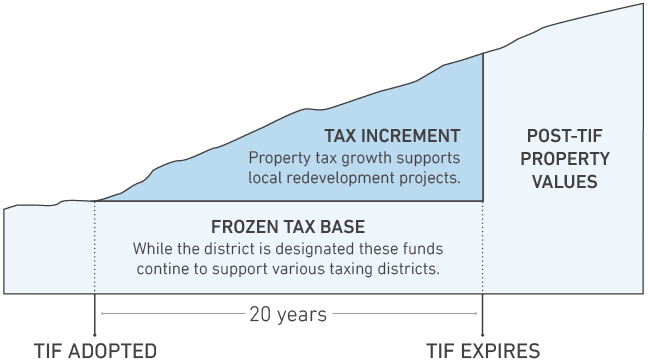
When a district is formed, the assessed value of its property is recorded as the base. Taxes on that base continue to support the existing taxing districts. As property values rise, taxes generated by the increase—the <em>increment</em>—fund eligible improvements within that urban renewal district. The district does not impose a new property tax. When it closes, the increased value returns to the regular tax rolls for the other taxing districts.
The Agency has established a total of seven tax allocation areas (aka districts) since 1987.
Central District
River Myrtle – Old Boise District
Westside District
30th Street District
Shoreline District
Gateway East District
State Street District
As of 2026, the Agency has completed its work and ended its involvement with three of those districts: Central, River Myrtle-Old Boise, and Westside. The work performed in those three districts – and the effect of CCDC’s use of the tool of urban renewal, are the focus of this website.